Until required to learn otherwise, I always assumed Rossini, like his adored Mozart or his close contemporary Schubert, must have died young. Gregarious and shrewd, addicted to witty antics and a prodigious worker, Rossini had written all 39 of his operas by the age of 37. If the stories of his industry are true – did he really dash off that impeccable comic masterpiece, Il barbiere di Siviglia (1816), in only 13 days? – he could well have been struck down early.
Instead he lived another 40 years, completing a few works but no more operas. The enchanting Petite messe solennelle (1863), which he called one of the “sins of his old age”, dates from the period. He worried about its liturgical status, convinced it or he must be damned since he was a man born to write comic operas not masses. Despite Rossini’s flair and genius he was prone to depression and anxiety, never far from mind when you hear his dazzling, irrepressible, speedy music.
Of which there is a glut right now. Royal Opera’s recent Il barbiere di Siviglia, Welsh National Opera’s double dose of Moses in Egypt and William Tell, Scottish Opera’s La Cenerentola and La scala di seta, which has just opened at the ROH Linbury. Surely a Rossini anniversary? No, though why not celebrate 222 years since his birth and 146 since his death?
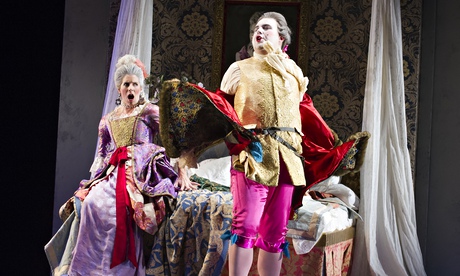
The shortest and most engaging was La scala di seta (1812) in the Linbury Studio, the first staging of this work at the Royal Opera House. A compact new production by Greg Eldridge, elegantly and minimally designed by Holly Pigott, gave six of the Royal Opera’s Jette Parker young artists a chance for comedy and vocal virtuosity. Rossini was 20 when he wrote this farsa comica. Characters who appear stereotypes – the shrewd soprano heroine, her handsome tenor lover, the buffo bass nobleman – are a little more rounded than that, and pave the way for Barbiere.
No one shins up the silken ladder of the title, but they do climb up a flowering cherry tree that springs out of a canopied bed. In a Rossini farce, anything goes. The main lovers, Lauren Fagan (Giulia), pert and characterful, and Luis Gomes, gloriously agile in voice as her lover, are well equipped for this difficult repertoire. The rich-toned Anush Hovhannisyan, Samuel Dale Johnson’s sanguine Dormont and Yuriy Yurchuk’s ardent Germano all showed talent. James Platt (Blansac), pink-cheeked with foppish wig, might have been playing buffo roles for a lifetime. Jonathan Santagada conducted the lean and nimble Southbank Sinfonia. This sunny Meet the Young Artists week event lifted the spirits.
Scottish Opera’s La Cenerentola – a new co-production with Strasbourg’s Opéra national du Rhin conducted by William Lacey – has much charm but cannot quite disguise the longueurs in this version of the Cinderella story, not so much fairytale as gentle romance. The cast is uneven but rejoices in a stunning Angelina/Cenerentola (the Russian mezzo Victoria Yarovaya), two fine ugly sisters (Rebecca Bottone and Máire Flavin) and some deft support (the buffo Umberto Chiummo and Richard Burkhard’s excellent Dandini).
Making her Scottish Opera debut as Cinders, Yarovaya has vocal warmth and pliancy as well as a sympathetic stage presence which made the title role – especially in the showpiece Nacqui all’affanno – a touching embodiment of goodness. Director Sandrine Anglade and designer Claude Chestier came up with some compact devices, no doubt good for touring: several wooden armoires which suggested manorial bookcases were useful for characters to disappear into. The male chorus wore illuminated rubber-ring ruffs whose purpose – white tyres, early motoring style – became clear when they turned themselves into (I think; if not what on earth were they up to?) a charabanc, with other chorus members swirling white umbrellas. This was my third opera with swirling white umbrellas, which may be enough. The first night needed a boost of adrenaline, on stage and in the pit, but the ingredients are there and it will surely blossom.
Owing to a date clash at the Cardiff opening, I saw Welsh National Opera’s Moses in Egypt on the first leg of its tour, in Oxford’s New theatre. The particular pleasure here – though not for all; it is quite a distraction – is the absence of a pit, which shone an unforgiving spotlight on WNO’s terrific orchestra. There was no need to worry: every player was on his or her mettle, under the incisive baton of Simon Phillippo. The WNO chorus was, as usual, outstanding and I was sorry to have to miss the company’s William Tell, Rossini’s last, ambitious undertaking for Paris, on tour until 22 November.
The production team – director David Pountney, designers Raimund Bauer and Marie-Jeanne Lecca – kept all simple, colour-coding Hebrews in blue-green work clothes, and Egyptians in earth-red with ancient-inspired detail. The story unfolds like a highly dramatic oratorio, with big moments but a fair amount of padding, unless you’re a true Rossini addict. The cast had many British stars, including Barry Banks and Nicky Spence, and was led by an insightful, generous Christine Rice as Amaltea, the pharaoh’s wife, and the wonderfully versatile Claire Booth as the Hebrew Elcia. It’s a bumpy piece with several gems, such as an exquisite vocal quartet with solo harp. The finale is prolonged, with several short scenes and too much curtain up-and-downing. Yet the music grows ever more captivating. You might even say the nearer it got to the end, the better. Then the Red Sea parts, efficiently if not spectacularly, and it’s all over, just like that.
Star ratings (out of 5)
La scala di seta ****
La Cenerentola ***
Moses in Egypt ****
