
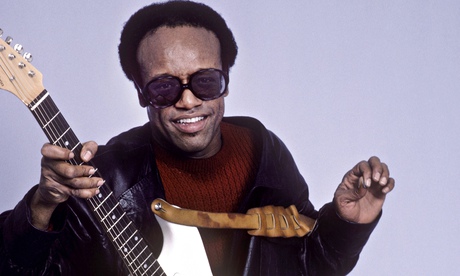
I got to know Bobby’s music through his 80s output. His was a voice that cut through the radio. You couldn’t forget it as soon as you’d heard it. When I was working with Gil Scott-Heron we both made lists of songs that we thought would be interesting to cover and Gil had Harry Hippie by Bobby on this list. I think all Bobby’s peers were fans and admirers of his because he was such a great musician. Some of the best records of all time have got his guitar work on – Sly Stone, Aretha Franklin. It’s almost as distinctive as his voice.
Damon [Albarn] had reached out to find Bobby when he was making the Gorillaz record [2010’s Plastic Beach]. I was extremely excited. When you hear a voice you haven’t heard for a long time there’s a certain trepidation – is it still going to carry the magic – but Bobby sounded fantastic. He wanted Damon to help him make a record and Damon suggested the three of us do the sessions together.
Bobby had been let down in the past but when he saw that Damon kept his promises, it was a great start. It was the first of many pleasant surprises that Bobby was so happy to be there. You don’t necessarily expect someone with achievements at that level to be enthusiastic. He felt like he hadn’t been fully heard and he was getting a shot at being heard and I think that gave him a tremendous amount of motivation.
He also felt like he’d outlived most of his peers. He’d been spared to communicate more with people and put some more soul music out there. He had something he wanted to say, which is maybe why people connected with this record [The Bravest Man in the Universe]. He wasn’t going through the motions. When Bobby would really let rip in the studio it was otherworldly. His voice was a completely unique, God-given instrument. He suggested that we create a band for him to play the new material, so we found ourselves playing shows with him, which is one of my all-time best life experiences. He was amazingly good company. He had a very off-the-wall sense of humour. He came from a place where you had to be quite tough, and he was, but there was a real softness and vulnerability that made him enormously likeable.
He’d really lived. This idea of the rock’n’roll lifestyle that got co-opted by white musicians, Bobby and his peers invented that and did it all to the nth degree. He used to tell us stories about things he got up to with James Brown and Sly Stone in the 70s. They had some insane adventures and were making music that was going to last for ever.
He wanted to work. What he didn’t want was to be talking about his health. He didn’t want that to be what his life was about. He probably kept us in the dark in terms of what was going on. I don’t think he wanted us to think of him that way. I got very sick so the last time I saw Bobby was in a neurological ward with him visiting me. He turned up out of nowhere. It was a really uplifting surprise visit. I spoke to him some time after that and he was saying, “You’ve got to take it easy,” and I said, “Well, I don’t see you taking it easy!”
We should have been in the studio right now, making a record of spirituals. Me and Damon both felt incredibly lucky to have been around him, listened to him, learned from him. I had people saying, “It’s great that you’ve done this for Bobby,” almost like we were doing him a favour. It was the opposite. I was very grateful. He made every moment a pleasure.
