
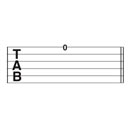
Tab explanation
Guitar music is presented in the form of tablature (tab). Tab consists of six horizontal lines representing the six strings on a guitar. The lowest line is for the thickest string on the guitar (the one nearest to you when you're looking down at a guitar you're holding), the sixth string known as "low E". The highest horizontal line is for the thinnest string, known as "high E".
If a "O" is shown on the top line, that's an open (unfretted) string on the first string. If a "1" is shown on the top line, that represents a finger placed at the 1st fret on the first string.
A down-pick or downstrum (towards the floor) is indicated by a symbol that looks like a hurdle. An up-pick (pick upwards, ie. towards your face) has a "V" symbol.
Not all notes are sounded by picking or strumming. Instead, techniques known as hammer-ons and pull-offs are used. These are indicated by an extended bracket over two fret numbers.
Vertical lines attached to the fret numbers are used to represent rhythms. A note lasting for four beats (one bar's worth) does not have a line attached. For either a two-beat or a one-beat note, a vertical line is attached to the fret number. A note lasting for half a beat (also known as an eighth note) is represented by a fret number attached to a vertical line with a "tick" on either the top or bottom. If you have several of these notes together they will be connected by a horizontal bar.
Tuning the guitar
There are many different ways of tuning the strings on your guitar (and they are all worth investigating once you have become a little more proficient), but in this guide we will be sticking to the most common, known as 'standard tuning'.
Going from the thickest string downwards, this is:
E, A, D, G, B, E
Check the tuning every time you play the guitar - an out-of-tune instrument makes it even harder to learn, as nothing is going to sound right.
