
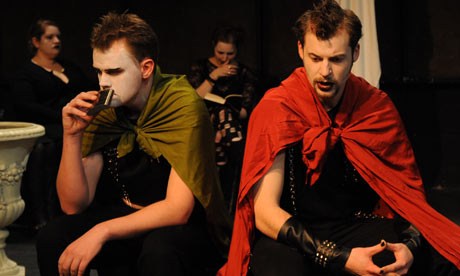
Formed by graduates from the Royal Northern College of Music, Elemental Opera is a newish company, whose aim is to bring a back-to-basics approach to the 20th and 21st-century repertoire. But whether their production of Britten's The Rape of Lucretia ideally fulfils their intentions is debatable.
The piece is tricky. Britten has been accused of presenting Lucretia as "asking for it", while the Christian gloss that overlays the brutal pagan narrative now strikes us as smug. Director Gavin Magenty's solution to the work's problems is to present the Male and Female Choruses (Brian Smith Walters and Janet Fischer) as a traumatised Christian couple, concerned for the safety of their teenage daughter, who is involved with the thuggish leader of a gang of punks.
This doesn't always clarify matters. Tarquinius (Benjamin Weaver) and the thug are soon linked in the daughter's mind, which allows Magenty to make the point that neither the girl's wide-eyed naivety, nor the sensual self-assurance of Diane Hatfield's happily married Lucretia constitute complicity with male violence. Furthermore, Magenty's decision to give the Choruses a private agenda and a daughter skews Britten's purpose in presenting them as detached, almost Brechtian observers, while his re-imagination of the narrative in terms of urban violence allows him to duck the anti-war subtext that links ideas of sexual and military conquest.
Musically, meanwhile, things are also uneven. Weaver, obscene and infantile, and Hatfield, sounding beautiful, give notably fine performances. Fischer is fiery and commanding, though Smith Walters is occasionally effortful. Adam Johnson's conducting is more incisive and committed than the playing, some of which is on the tentative side.
